

Micronutrients

Vitamin A: Need, effect & deficiency

Person in a white shirt taking a photo with a camera on a beach, wearing a watch, with blurred mountains and ocean in the background.

Lisa Ressi, MSc

16.09.20244 Reading time

Vitamin A is an essential vitamin that plays an important role in numerous bodily functions. In this article, you will learn all the important information about the requirement for, the effect and the possible consequences of vitamin A deficiency.

01

What is vitamin A?

Vitamin A is a fat-soluble substance that is found in two main forms:

  • as retinol found in animal products and

  • as provitamin A (beta-carotene), found in plant-based foods.

While retinol can be used directly by the body, provitamin A (beta-carotene) must first be converted into the active vitamin A form.

Occurrence of vitamin A in food

Vitamin A is particularly present in high concentrations in liver and products containing liver. Other animal foods such as eggs and some fish (e.g. eel) also contain significant amounts of the vitamin.

In plant-based foods, vitamin A is not directly present, but rather in the form of provitamins such as beta-carotene and alpha-carotene, which the body uses as vitamin precursors. Some of these provitamins are already converted into vitamin A in the small intestine (approx. 17%). The other part is further metabolised into vitamin A by the liver, lungs, kidney and muscle cells after absorption into the body. Key plant sources of provitamin A carotenoids include vegetables such as carrots, pumpkin, red peppers, lamb’s lettuce, spinach and kale. People who rarely consume vitamin A-rich animal foods (e.g. liver) in particular should use these plant-based sources of vitamin A. In this case, it is necessary that the meal also contains fat to allow the vitamin to be absorbed into the body. Animal foods usually provide enough fat, so extra fat is not required.

An adequate supply of vitamin A is also possible in a purely plant-based diet, provided there are no digestive problems or fat digestion disorders and there are also sufficient active conversion enzymes. Furthermore, an adequate thyroid function is also crucial for the efficient conversion of provitamin A carotenoids to vitamin A.

02

Vitamin A and its effect

Vitamin A is involved in numerous metabolic processes. The best known function is probably its role in vision. It is a component of the visual pigment rhodopsin, which makes it possible to see in poor light. In addition, vitamin A supports the growth and differentiation of cells that are important for the renewal of the skin and mucous membranes. Our immune defence also benefits from strengthening the external body barriers. In addition, vitamin A supports the innate and acquired immune system by promoting the formation of white blood cells and thus helping to fight off infections. The fat-soluble vitamin also plays a role in maintaining the higher functions in the central nervous system. Adequate vitamin intake also promotes fertility. On the one hand, it contributes to the formation of the two sex hormones testosterone and oestrogen; on the other hand, it is also important for sperm production and quality as well as for egg cell, placental and embryonic development.

03

Daily vitamin A requirement

The daily need for vitamin A depends on age, gender and individual circumstances. The recommended daily dose for adults is:

  • Men: 850 μg retinol equivalent (RE)

  • Women: 700 μg RE

Pregnant and breastfeeding women have an increased need for vitamin A to support the healthy development of the child. Similarly, people with certain diseases that affect fat absorption may have a higher need.

Vitamin A during pregnancy, lactation and if you wish to have children

Vitamin A plays a role in the desire to have children. It helps in the production of testosterone as well as in the development of sperm cells and the placenta. However, even during pregnancy, a sufficient vitamin A supply is particularly important, as it affects cell division and the normal development of the embryo.

However, caution should also be exercised: Excessive intake of vitamin A, especially in the form of retinol, can be harmful during pregnancy. Therefore, women in this phase should pay particular attention to a balanced intake of food and should only take vitamin A preparations after consultation with their doctor.

Vitamin A in children

Vitamin A is equally important for children as it promotes growth and vision. Children between the first and fourth years of age require approximately 300 μg retinol equivalent (RE) per day, while older children and adolescents require between 350 and 950 μg RE, depending on age and gender.

Age

Male

Female

0 to under 4 months

500*

500*

4 to under 12 months

400*

400*

1 to under 4 years

300

300

4 to under 7 years

350

350

7 to under 10 years

450

450

10 to under 13 years

600

600

13 to under 15 years

800

700

15 to under 19 years

950

800

* This is an estimate of the µg/day.

04

Vitamin A deficiency: Influencing factors and symptoms

Vitamin A deficiency is common in developing countries, but can also occur in developed countries if the diet is permanently one-sided or certain diseases impair vitamin absorption. Typical symptoms of vitamin A deficiency include night blindness, increased susceptibility to infection, dry skin and corneal changes in the eye. In children, a deficiency often manifests as growth disorders and an increased susceptibility to disease.

05

Supplementing vitamin A: Vitamin A capsules, etc.

Supplementation may make sense for people who do not consume sufficient vitamin A through their diet or who have an increased need. There are various forms of food supplements, including vitamin A capsules, drops or multivitamins. It is important not to exceed the recommended dose.
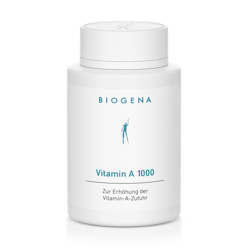
The fat-soluble vitamin for vision, skin and the immune system.
Vitamin A 1000

Vitamin A 1000

€20.90
Buy now

Lisa Ressi, MSc

Expert in knowledge management & speaker

Lisa Ressi is a certified Health & Care Nurse with a Master's degree in Health Sciences. Her heart has been in micronutrients for over 20 years. During her work as a freelance health and care nurse, she also gained a lot of practical experience with micronutrients. 

Her journey at BIOGENA began in 2014. In addition to her work as a micronutrient consultant at the BIOGENA store in Linz, she has created the Micronutrient Coach® compact course with great commitment and love. She has been a member of the BIOGENA science team since 2022 where she fulfills her great passion for knowledge transfer. True to the motto “Knowledge creates health”, she shares her knowledge in lectures, seminars, podcasts and even contributions in a very practical way with all those who are interested in promoting health and supporting therapy with micronutrients.

FAQs

Frequently asked questions about vitamin A:

Further reading:

Alkhouri, R. H. et al. 2012. Vitamin and Mineral Status in Patients with Inflammatory Bowel Disease. J Pediatr Gastroenterol Nutr. 56 (1):89-92.

Bao, Y. et al. 2012. Low maternal retinol as a risk factor for schizophrenia in adult offspring. Schizophr Res. 137(1-3):159-65.

Beurskens, L. W. et al. 2010. Retinol status of newborn infants is associated with congenital diaphragmatic hernia. Pediatrics. 126:712-720.

Biesalski, H. C. et al. Ernährungsmedizin: Nach dem Curriculum Ernährungsmedizin der Bundesärztekammer und der DGE, 4. Auflage. Stuttgart: Georg Thieme Verlag, 2010.

Biesalski, H. K., Nohr, D. 2004. New aspects in vitamin a metabolism: the role of retinyl esters as systemic and local sources for retinol in mucous epithelia. J Nutr. 134(12 Suppl):3453S-3457S.

Bonifant, C. M. et al. 2014. Vitamin A supplementation for cystic fibrosis. Cochrane Database Syst Rev. (5):CD006751

Bonifant, C. M., Shevill, E., Chang, A. B. 2012. Vitamin A supplementation for cystic fibrosis. Cochrane Database Syst Rev. 8:CD006751.

Checkley, W. et al. 2010. Maternal vitamin A supplementation and lung function in offspring. N Engl J Med. 362(19):1784-94.

Checkley, W. et al. 2011. Supplementation with vitamin A early in life and subsequent risk of asthma. Eur Respir J. 38(6):1310-9.

Clagett-Dame, M., Knutson, D. 2001. Vitamin A in reproduction and development. Nutrients. 3:385-428.

Elmadfa I., Leitzmann C. (2004) Ernährung des Menschen. 4. Auflage. Verlag Eugen Ulmer, Stuttgart

Fiebrich, H. B. et al. 2010. Deficiencies in fat-soluble vitamins in long-term users of somatostatin analogue. Aliment Pharmacol Ther.32(11-12):1398-404.

Fisher, G. J., Voorhees, J. J. 1996. Molecular mechanisms of retinoid actions in skin. FASEB J. 10(9):1002-13.

Gely-Pernot, A. et al. 2012. Spermatogonia differentiation requires retinoic acid receptor γ. Endocrinology. 153(1):438-49.

Glover, J. C., Renaud, J. S., Rijli, F. M. 2006. Retinoic acid and hindbrain patterning. J Neurobiol. 66:705-725.

Gröber, U. Mikronährstoffe: Metabolic Tuning – Prävention – Therapie, 3. völlig überarbeitete und erweiterte Auflage. Stuttgart: Wissenschaftliche Verlagsgesellschaft Stuttgart, 2011.

Gröber, U. Orthomolekulare Medizin. Ein Leitfaden für Apotheker und Ärzte, 3. Auflage. Stuttgart: Wissenschaftliche Verlagsgesellschaft, 2008.

Hahn, A. et al. Ernährung: Physiologische Grundlagen, Prävention, Thera-  pie, 2. Auflage. Stuttgart: Wissenschaftliche Verlagsgesellschaft, 2006.

Hogarth, C. A., Griswold, M. D. 2010. The key role of vitamin A in spermatogenesis. J Clin Invest. 120:956-962.

Hoover, L. L., Brooks, B. A., Kubalak, S. W. 2008. The expanding role for retinoid signaling in heart development. Sci World J. 8:194-211.

Jiang, W. et al. 2012. Vitamin A deficiency impairs postnatal cognitive function via inhibition of neuronal calcium excitability in hippocampus. J Neurochem. 121(6):932-43.

Kaufman, D. R. et al. 2011. Vitamin A deficiency impairs vaccine-elicited gastrointestinal immunity. J Immunol. 187(4):1877-83.

Kim, S. C. et al. 2012. Vitamin A deficiency induces fluid hyposecretion from the airway submucosal glands of mice. J Nutr. 142(4):739-43.

Leitzmann, C. et al. Ernährung in Prävention und Therapie: Ein Lehrbuch, 3. Auflage. Stuttgart: Hippokrates Verlag, 2009.

Ono, K., Yamada, M. 2012. Vitamin A and Alzheimer‘s disease. Geriatr Gerontol Int. 12(2):180-8.

Quadro, L. et al. 2005. Pathways of vitamin A delivery to the embryo: insights from a new tunable model of embryonic vitamin A deficiency. Endocrinology. 146:4479-4490.

See, A. W., Clagett-Dame, M. 2009. The temporal requirement for vitamin A in the developing eye: mechanism of action in optic fissure closure and new roles for the vitamin in regulation cell proliferation and adhesion in the embryonic retina. Dev Biol. 325:94-105.

Silva, I. T. et al. 2013. Is plasma alpha-tocopherol associated with electronegative LDL in obese adolescents? J Nutr Sci Vitaminol (Tokyo). 59(2):100-7.

Feel-good News

Everything about supplements, health tips and understandable study results directly from experts.
Show all articles

Sign up for our newsletter and get a €10 voucher

Sign up for our newsletter, receive your personal €10 voucher and look forward to exciting insights into the latest product innovations, giveaways and health tips – so you'll be well accompanied on your journey to well-being.