

:quality(70))
01
What is PMS?
Almost every woman has experienced premenstrual syndrome (PMS) in her body or via her moods. For everyone it’s different, because PMS includes a range of more than 150 physical and mental symptoms that occur in varying intensity and frequency in the days before your period, but then disappear once it starts.
Approximately 25% of all women suffer from this phenomenon every month, whereby the main complaints affect those over 30. Approximately 3 to 8% of women suffer from a particularly stressful form of PMS, so-called premenstrual dysphoric disorder (PMDS). Those affected turn into a different person in the second half of the cycle – they behave in an unusually tearful, depressed, irritable and sometimes even highly aggressive manner.
It is the days before a period when many women suddenly feel uncomfortable in their own skin. The recurrent ups and downs of hormones not only decide on the fertile and infertile days of a woman, but can also darken physical and mental well-being.
02
What are the causes of PMS?
The exact triggers of PMS are still not fully known despite decades of research. It is certain that PMS is cycle-dependent. This is because the symptoms always occur in the second half of the cycle – when progesterone increases and the oestrogen level decreases. But not every woman reacts in the same way to hormone fluctuations. For example, amongst women with an identical hormone status, there are some who suffer from PMS, whilst others do not.
This brings additional factors into play. In addition to lifestyle and genes that make certain hormones more sensitive, there is the influence of various messenger substances and hormones (including melatonin, prolactin and cortisol). The happiness hormone serotonin, whose concentrations drop gradually in the second half of your cycle before they hit rock bottom shortly before your period, could be of particular interest in this context. Women with PMS seem to be lacking a big dose of happiness in particular, because they generally have less serotonin than women who experience the second half of their cycle without symptoms.
03
How long does PMS last?
The premenstrual syndrome is a condition that affects the second half of the cycle and can wreak havoc a few days to a full two weeks before your period. The symptoms improve radically once your period starts.
04
Typical PMS symptoms
Your breasts are taut, you back painful, you break out in spots and your mood is at rock bottom. PMS is a real kaleidoscope that illustrates different facets in every woman. Some of those affected can be plagued by one or two symptoms only, whilst others experience a whole spectrum of symptoms.
Typical physical PMS symptoms include:
Taut breasts
Bloating
Cravings or loss of appetite
Feeling of pressure in the lower abdomen
Distended abdomen
Weight gain
Hot flushes, sweating
Skin blemishes
Circulatory problems including dizziness
Typical psychological changes during PMS are:
Irritability
Mood swings
Lack of desire
Exhaustion
Sleep disorders
Depression
05
What helps with PMS? Our natural tips:
Healthy comfort food. When we are in the grip of PMS, our desire for sweet and salty food increases. Nevertheless, we should remain firm and show this unhealthy comfort food the cold shoulder. It is now generally recognised that we can get through PMS better with a healthy diet. Fresh vegetables, whole grain products, legumes, fish, cold-pressed vegetable oils and nuts and seeds provide us with plenty of vital substances, keep blood sugar levels stable and can help us to get a grip on extreme hunger attacks.
Micronutrient companion. In order to help us to feel more lighthearted even on the days before menstruation, certain micronutrients can be used as a support. Vitex agnus-castus (also called Vitex, Chaste Tree, Chasteberry, Abraham's Balm or Monk's Pepper) is particularly recommended, as it can alleviate physical and psychological symptoms before and during your period due to its hormone compensating effect. In addition to calcium and vitamin D, a good iron supply also reduces the risk of PMS and also fights fatigue and exhaustion. Vitamin B6, which regulates hormone activity and is important for the formation of the two mood enhancers dopamine and serotonin, is also beneficial.
Goodbye to stimulants. The traditional stimulants of “civilised society”, caffeine, alcohol and nicotine, can trigger symptoms before menstruation. If we do without these stimulants in the second half of our cycle, this may alleviate the symptoms of PMS.
Treat yourself to peace and quiet. Stress and a lack of sleep not only strains our nerves but can worsen existing symptoms. It is therefore all the more important to treat yourself to enough sleep and rest breaks in the days before menstruation. We can also reduce stress and regain more lightheartedness through relaxation techniques such as yoga, meditation or a substantial forest bath.
Get active. On the days before menstruation, your oestrogen level decreases – and with it yourwell-being. Even if we would prefer just to lie on the couch, movement can do us good right now. Happiness hormones are released, water deposits are removed more quickly. At the same time, our circulation is increased and uterine cramps become less tense, which can alleviate pain in the lower abdomen and back.
The word cholesterol is derived from the Greek and means “bile” (Greek chole) and “solid” (Greek stereos). Cholesterol – hardly any other food component has such a bad image as this fat-like substance. But cholesterol per se is not bad at all – it is even vital for our organism. As an essential building block of our cell membranes, cholesterol is indispensable for our body, gives the cells stability and serves as a “sluice” for the absorption and release of substances. In addition, cholesterol serves as a preliminary stage for certain hormones, it is involved in the production of bile acids and is required for the body's own formation of vitamin D.
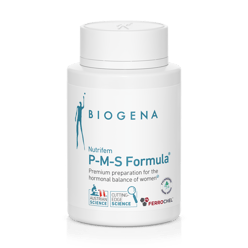
Nutrifem P-M-S Formula®
06
Significant results in BIOGENA product study: P-M-S Formula®
Over 50% increase in well-being
Despite “those days before the days”: Enjoy life in a good mood and full of energy.
The study product Nutrifem P-M-S Formula® offers an effective way to ease the burden of the "days before the days" and helps maintain mood, performance, and overall well-being.
For years, BIOGENA has been dedicated not only to developing the highest-quality products but also to strengthening the scientific foundation behind them. In the current study, 68 women suffering from PMS participated. Using the standardized WHO-5 questionnaire, their subjective well-being and performance during the days before menstruation were recorded—both before and after three months of taking BIOGENA P-M-S Formula®.
The study results speak for themselves:
Over 40% reported feeling less tired, and nearly 50% felt more energetic and generally better overall.
:quality(70))
:quality(70))
:quality(70))
:quality(70))
:quality(70))
:quality(70))
:quality(70))
:quality(70))
:quality(70))