

:quality(70))
01
What is menopause?
The menopause includes the years before and after the last menstrual period. During this time, the female body undergoes a strong hormonal change, which can be experienced both on a physical and a mental level. Because every woman is unique, it follows that the experience of menopause is just as varied. While some women find the menopause plain sailing that they get through with equanimity, others find themselves battered by emotional storms and a host of unpleasant physical changes.
02
How your body changes during menopause
Regardless of whether you are the type who is more laid back or who loves to be right in the thick of things – what all women have in common during menopause is that their hormones are undergoing a total refurbishment. And this hormonal change does not occur overnight, but extends over an average period of ten years. In the course of this, the body’s metabolism also changes. The body now needs fewer calories and the actual composition of the physique changes too. Whilst the muscle mass that kept us in shape goes downhill, a lot of women find they tend to put on weight more easily around the waist.
:quality(70))
Illustration: The phases of change
03
Understanding the menopause phases
The premenopause – the warm-up.
Around the age of 40, the menopause gradually makes itself felt as the most fertile period of a woman’s life slowly comes to an end. The ovaries start to no longer produce a mature egg on a regular basis (i.e. during each cycle). As a result, ovulation and ripening of the corpus luteum are also no longer so regular, and progesterone formation decreases. The oestrogen level remains constant in this phase. What is happening internally often also manifests itself externally too.
Possible signs
- Premenstrual:
o Taut breasts
o Water retention
o Mood swings
o Headaches
· Cycle changes (e.g. prolonged or shortened cycles, more severe bleeding)
The perimenopause – the phase of intense change
In this central phase of the menopause, things really hot up in the truest sense of the word. Oestrogen production also begins to decline as egg cells mature more and more rarely. In order to compensate for the hormone deficiency, the brain releases more and more of certain messenger substances (FSH and LH). These are designed to encourage the ovaries to resume their original hormone production. However, while the FSH and LH concentrations increase, the oestrogen levels continue to decrease. The heated interaction between the sex hormones and the messenger substance ultimately leads to the classic signs of menopause. On average, women are 47 years old at the beginning of the perimenopausal period, with menstrual bleeding ending about 4 years later.
Possible signs
- Problems with menopause
o Hot flushes, turning pink or red
o Sweating attacks, night sweats
o Sleep problems
o Mood swings
o Moods and malaise
· Cycle disorders (e.g. intermenstrual bleeding, spotting, long or very short breaks between cycles)
The menopause
At some point in life, every woman reaches an age at which her egg cell stocks are coming to an end and ovulation has finally completely come to an end. The last menstrual period, which takes place at 51 on average, is called menopause. However, the fact that it was her last menstrual period only becomes plain to a woman after one year. By this time, the body has already come to rest at a new hormone level.
The post-menopause – the showdown. Twelve months after the last period, the final phase of the menopause begins, during which the female hormone balance gradually calms down. Many women experience relief from the classical menopause symptoms due to the reduced hormone metabolism. New complaints can occur, however, due to the low oestrogen level.
Possible signs
- Post-menopause
o Sleep problems
o Fatigue, lack of drive
o Moods and malaise
o Reduced libido
o Dry mucous membranes and more mature skin
o Thinning hair
04
Menopause – also a men’s topic?
In men aged around 40 the testosterone level also begins to decrease slowly. Unlike women, in whom the level of sexual hormones decreases in bursts, menopause develops continuously but gradually over the years in men. Since this allows the male body to adapt better to the respective hormone level, menopause is only noticeable slowly and less intensively. About half of men don’t even realise they are going through menopause. In addition, the “stronger sex” often tends to ignore, conceal or take less seriously age-related changes and impairments.
Possible signs
o Fatigue, lack of drive
o Increase in abdominal fat
o Decreasing muscle strength and mass
o Tenseness
o Reduced libido
05
7 tips for managing menopause symptoms
1) Micronutrient retention
Those who are going through menopause can use some internal support as well. This is where the B vitamin family comes into the spotlight. On the one hand, representatives of the vitamin family such as thiamine play a role in energy metabolism, and on the other hand, B vitamins such as niacin and biotin also support the normal function of the nerves and mind. Vitamins B6, B5 (pantothenic acid) and B2 are particularly interesting in this context. While vitamin B6 participates in the regulation of hormones and pantothenic acid in the production and metabolism of steroid hormones (e.g. oestrogen), vitamin B2 contributes to the maintenance of normal mucous membranes. The B vitamins are actively assisted by magnesium, which participates in similar areas in the body – i.e. energy and nerve metabolism as well as in terms of the mind – and together with vitamins D and K contributes to maintaining bone health.
2) Herbal companions
Certain plant extracts can also be recommended to women when they are during the menopause. Wild yam root has a long tradition as a supplement during the menopause. Yam extract supports women during the menopause by contributing to the reduction of menopausal symptoms – such as hot flushes, sweating and restlessness. Ashwagandha and hops have also been proven to be effective when sleep is sometimes difficult at night. While Ashwagandha supports the period of sleep, hops contribute to normal sleep.
3) Caution: sweat inducing!
If you have to contend with hot flushes and sweating, you should exercise caution with alcohol, hot spices and hot drinks. These foods dilate the blood vessels and promote sweating.
4) Power away hot flushes
Women who rarely exercise suffer from hot flushes three times as often as their more athletic peers. Endurance sports (e.g. mountain hiking, walking, jogging, swimming), where the body is made to react to temperature fluctuations are particularly recommended. In addition, your bone health, weight and mind also benefit from exercise.
5) Chilled out is better
Life is easier if you’re relaxed – even in the menopause. This means that many complaints (e.g. hot flushes and sweating) lose their power once you are able to relax. For example, special aroma baths, a soothing forest bath, a short meditation session or yoga have a relaxing effect. For the latter, so-called “hormone yoga” is particularly recommended.
6) Wrap up cool
Cold compresses made from sage or mint tea help you to keep a cool head when sweating attacks occur. While the menthol in mint cools the body, sage counteracts heavy sweating.
7) Positive attitude
A positive attitude towards life helps to get through menopause better. Often also called “the change”, this period of life should be seen as an opportunity to reflect and, if necessary, to reorient yourself. After the needs of other people (children, partners, career, etc.) have been in the foreground for many years, the menopause can be an invitation to develop a kind of “healthy egoism”. If menopause and all that comes with it is accepted as a natural process, this time often no longer feels so strange.
Literature on request from the author.
Nutritional support for menopausal symptoms such as hot flushes, sweating or restlessnessFor the targeted supply of plant extracts from yam, fennel, hops, soya and monk's pepperFor hormonal balance and for the well-being of women of childbearing age
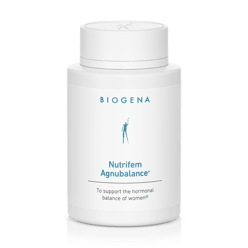
Nutrifem Agnubalance®
:quality(70))
:quality(70))
:quality(70))
:quality(70))
:quality(70))
:quality(70))
:quality(70))
:quality(70))
:quality(70))