

:quality(70))
01
#1 Don't just rely on calcium
It's easy to reach for pure calcium supplements – but that alone is not enough for strong bones. Studies show that calcium carbonate alone does not strengthen bones. Vitamin D, vitamin K, magnesium, phosphorus, boron and silicon are also important because they play a central role in bone metabolism.
Vitamin D not only supports the absorption of calcium from the intestines, but also controls its storage in the bones. Together with vitamin K, it ensures that calcium ends up exactly where it is needed – in your skeleton. Magnesium, phosphorus, boron and silicon complement the formula by promoting bone formation and strengthening bone structure.
Vitamin D also improves muscle strength in people over 60 and reduces the risk of falls – an important protection against bone fractures.
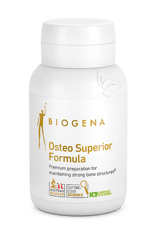
Osteo Superior Formula Gold
02
#2 Bone strengthening through nutrition
Fresh, balanced meals are the basis for strong bones and effective protection against bone loss and osteoporosis.
Foods for strong bones:
Food group | Examples | Bones-bonus |
|---|---|---|
Green vegetables & green kitchen herbs | Kale, broccoli, Brussels sprouts, parsley | Contain, among other things, plenty of vitamin K and magnesium. Valuable sources of alkalis |
Pseudograin | Buckwheat, amaranth, quinoa | Often rich in minerals such as calcium, magnesium, potassium and zinc |
Nuts, kernels, seeds | Almonds, sesame seeds, linseeds, poppy seeds | Provide calcium, magnesium, boron, etc. |
Soy products | Soybeans, tofu, seitan, tempeh | Provide isoflavones, potassium and magnesium, among other things |
Mineral waters with a high calcium content | Supplying calcium, potassium and magnesium in varying concentrations |
Table 1: Foods for strong bones
03
#3 Sport & exercise: Fit people, strong bones
Exercise is important – but not every sport strengthens bones equally. Swimming and cycling are good for your muscles and heart, but have little effect on bone density. For strong bones, weight-bearing activities such as gymnastics, strength training, Nordic walking, hiking, cross-country skiing or dancing are particularly important. Ball sports also effectively promote bone mass.
04
#4 No to nicotine
Smoking is not only harmful to your general health, but also to your bones. Narrowed blood capillaries make it more difficult for important nutrients to be transported to the bones. Reducing your cigarette consumption or quitting altogether is therefore not only good for your lungs, but also for your bones.
05
#5 Hello, normal weight!
Maintaining a healthy body weight is a real bone booster. Being overweight puts additional strain on the bones and makes movement more difficult. Chronic underweight also weakens the bones, as important nutrients are often lacking and, in women, the hormone oestrogen, which supports bone protection, is also lacking.
06
#6 Avoid hyperacidity
Too much animal protein and processed foods can cause excess acidity in the body. To balance this out, your body needs alkaline minerals, which are mainly found in unprocessed plant-based foods. If these are lacking, the body will draw on minerals from the bones – and this can weaken bone health in the long term.
07
Who really needs to strengthen their bones?
Although bone loss is often considered a “women's issue”, there are many other risk factors:
Women going through the menopause are particularly at risk because the bone-protecting hormone oestrogen decreases – the earlier the menopause, the higher the risk.
Men over the age of 60 can also lose bone density due to declining testosterone levels, albeit at a slower rate.
Anyone taking certain medications long-term, such as proton pump inhibitors or cortisone, should keep a close eye on their bone health.
Very slim people (BMI below 19), people with an unbalanced diet, little exercise, vitamin D deficiency due to little sunlight, smokers and people who consume a lot of alcohol are at increased risk.
Digestive problems and intolerances can interfere with the absorption of important nutrients and thus weaken the bones. In the case of lactose intolerance, bone protection is not a problem if calcium is obtained from alternative sources such as mineral water, nuts, vegetables or calcium supplements.
Vegans should also pay particular attention to calcium and vitamin B12, as many minerals and vitamins are important for healthy bones – in this respect, a vegan diet can even offer advantages over the average diet.
Conclusion: Strong bones are a long-term project
Our bone mass grows over many years – and unfortunately, it also slowly deteriorates again. The foundation for strong bones is laid at a young age. A varied diet rich in vitamins and minerals, combined with a healthy lifestyle and regular exercise, creates the basis for strong bones into old age. Women should pay particular attention to their bone density at the onset of the menopause, as bone loss accelerates at this stage. Anyone taking long-term medication should definitely discuss osteoporosis with their doctor and take preventive measures in good time.
:quality(70))
:quality(70))
:quality(70))
:quality(70))
:quality(70))
:quality(70))
:quality(70))
:quality(70))
:quality(70))