

:quality(70))
01
Is there such a thing as vegan collagen?
Strictly speaking, there is no real vegan collagen, because collagen can only be produced by humans and animals.
So when we talk about vegan collagen, we mean the collagen building blocks that the body needs to produce collagen itself. These include glycine, proline and lysine.
02
Effects and benefits of vegan collagen powder (procollagen)
Collagen doesn't just appear out of nowhere – the body builds it piece by piece. To do this, it needs amino acids from food, i.e. the small components of proteins. One amino acid plays the main role here: glycine.
Did you know that in a collagen molecule, every third amino acid is glycine? It is therefore no wonder that glycine is considered a central key amino acid. However, in order to produce enough collagen, your body must also have plenty of glycine available – and this is precisely where the challenge lies: glycine must be ingested in comparatively high amounts through diet for the body's collagen production to run smoothly.
That's why it can be useful to make sure you get enough glycine and other collagen-relevant amino acids such as proline and lysine – especially if you want to actively support your body's collagen production.
One advantage: vegan collagen alternatives do not contain any animal proteins that could be potential allergens (e.g. fish). This can reduce the risk of allergic reactions.

Premium ProCollagen & Hyaluron+
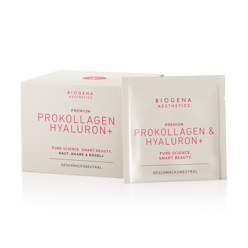
ProCollagen & Hyaluronic Acid+ Neutral
03
4 tips on how to include collagen in a vegan diet
Procollagen (collagen building blocks such as the amino acids glycine, proline and lysine) supplement
Additional micronutrients that stimulate collagen formation: vitamin C, zinc, copper & silicon
Exercise: Strength and endurance training stimulates the body's own collagen production because the connective tissue has to adapt.
Red light: Red light therapy penetrates into the deeper layers of the skin and can help to stimulate collagen production.
04
Plant-based collagen sources in food
Unfortunately, direct sources of collagen can only be found in animal-based foods. But don't worry, there are plant-based alternatives that can boost your collagen production thanks to the nutrients they contain! Quinoa and chia seeds are particularly recommended. Nutrients such as zinc from nuts, seeds, legumes and wholemeal products, and vitamin C from fruit and vegetables are also important for promoting the body's own collagen production.
05
Are vegan collagen alternatives as effective as animal collagen?
From a biochemical point of view, collagen consists of about one third glycine, followed by proline and other amino acids such as lysine. Vegan alternatives therefore contain these amino acids, which the body needs for its own collagen formation.
While animal collagen (as hydrolysate = small collagen fragments) is already available in a usable form, the body has to produce collagen itself from the vegan collagen building blocks. To ensure that this process works optimally, additional nutrients such as vitamin C, zinc, copper and silicon are particularly important.
Whether or not vegan alternatives are just as effective depends on various factors, including the body's individual ability to form collagen. Studies show that the supply of glycine in the daily diet is not sufficient to optimally support collagen synthesis. Taking the right amino acids as a supplement can therefore stimulate collagen production. This way, connective tissue can be supported even without animal collagen.
06
How does BIOGENA AESTHETICS produce vegan collagen?
The term procollagen refers to the precursor of collagen and, in the case of BIOGENA AESTHETICS ProCollagen & Hyaluronic Acid+, refers to the three amino acids glycine, proline and lysine. These are produced by different processes, such as fermentation, and are completely vegan. Since collagen consists of about one third glycine, followed by proline and other amino acids such as lysine, a targeted supply of these building blocks is essential. BIOGENA AESTHETICS ProCollagen & Hyaluronic Acid+ contains these amino acids in an ideal ratio to specifically support collagen formation.
07
Did you know that vegetarian collagen exists?
And that is the eggshell membrane OVODERM®: OVODERM® is a vegetarian raw material that is rich in important structural proteins such as collagen and elastin, but also contains hyaluronic acid. All three substances can also be found in our skin. OVODERM® is obtained from eggshell membrane, a natural component of eggshell, using a patented manufacturing process. Studies show that supplementation of OVODERM® reduces signs of skin aging and can improve the barrier function of human skin. In addition, taking eggshell membrane extract is effective in preventing and reducing the loss of moisture, firmness and elasticity. This raw material thus offers a perfect vegetarian collagen alternative.
:quality(70))

MiraSkin+ Superior
:quality(70))
:quality(70))
:quality(70))
:quality(70))
:quality(70))
:quality(70))
:quality(70))
:quality(70))
:quality(70))